
Killzonda · 7 day free trial

Trade with clarity.

Know your numbers.

Own your edge.

Meet Killzonda

7 days free · cancel anytime · about a quarter the price of the big name journals.

Log the trade. It works out the rest.

Three things worth looking at when you open the demo below.

  1. Five numbers that matter. Net P&L, win rate, profit factor, expectancy and drawdown, each measured against the period before.
  2. Your curve, and what you gave back. Cumulative P&L against its running peak. The gap between the two lines is the drawdown.
  3. Every trade leads with the chart. You recognise the trade before you read a single number, with the setup and result underneath.

What traders are saying

Killzonda is a great platform for learning from your mistakes and finding what makes a good day a good day, and a bad day a bad one. Tracking my MAE and MFE to find my strongest draw on liquidity turned out to be far more helpful than I expected.

JerryKillzonda user

Killzonda has paid for itself many times over. Going back through my metrics and trade data showed me exactly where I was losing money, and fixing it has saved me thousands of dollars. At a price this fair, the ROI is well worth it.

TylerKillzonda user

Every feature feels like it was built by someone who actually trades. The numbers keep me honest about what is working and what is not, and I can see myself growing as a trader. For a fraction of what the big-name journals charge, it is an easy yes.

DeniseKillzonda user

Reviews from Killzonda users. Individual results vary.

The real thing, not a screenshot

This is Killzonda itself, loaded with a month of example trades. Click through the tabs, change the date range, sort the table, open a day on the calendar.

One trade, opened

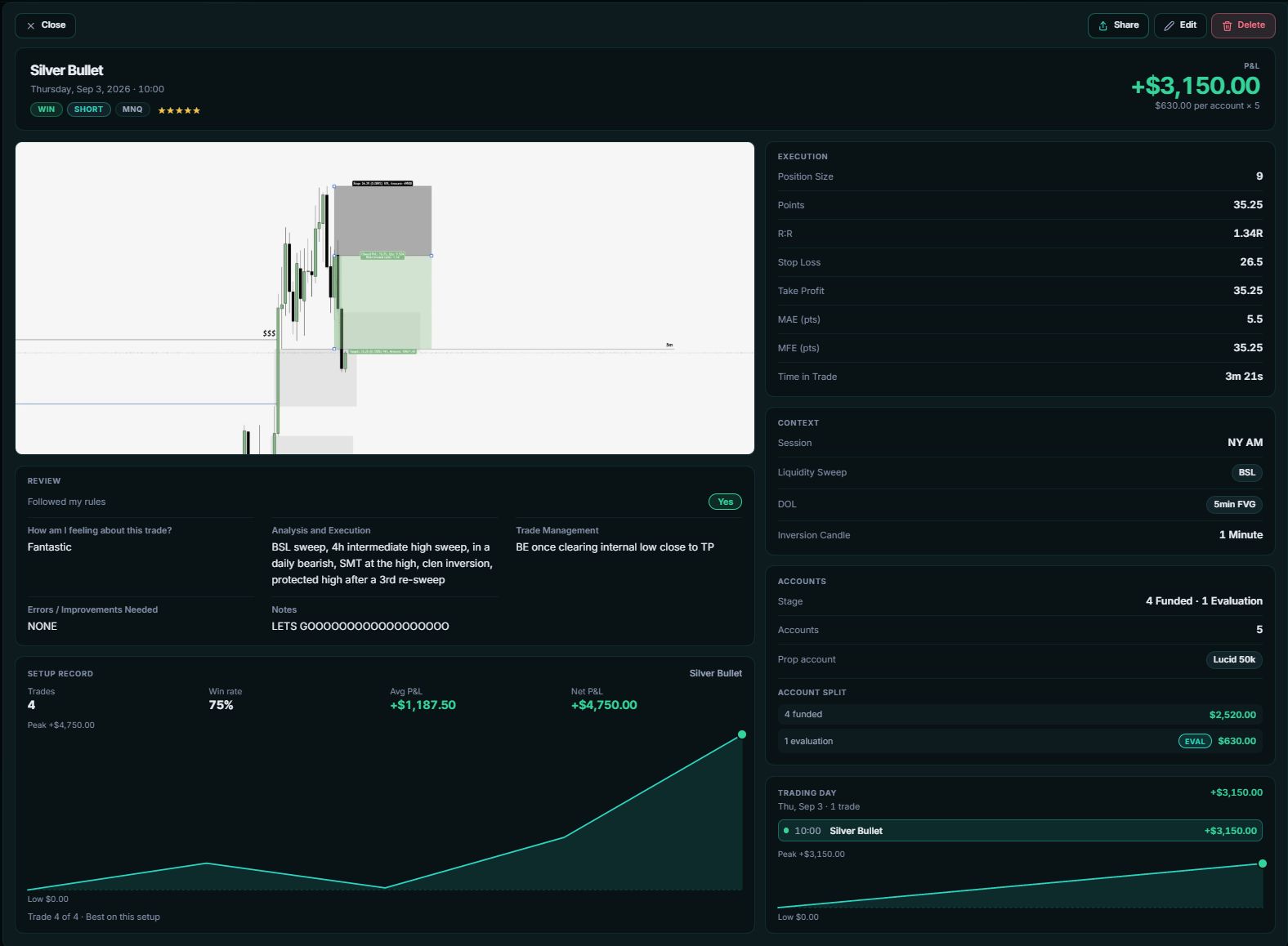
The chart you took it from, every field you logged, and the reflection underneath.

A logged trade opened in Killzonda: the annotated chart beside its execution, context and account cards (position size, R:R, stop loss, take profit, MAE, MFE, session, liquidity sweep and the funded and evaluation split), the trader's review underneath, and the setup's record and that trading day with running P&L charts.
Image-first trade logging Real P&L calendar Key metrics that actually matter Pre-market checklist built in
The method

Manual by design. That's the feature.

Auto-syncing from your broker sounds like less work, and it is. It is also less learning. You end up with hundreds of rows you never open again: reconciliation, not review.

The thirty seconds you spend typing in the setup, the session, the sweep and how you managed the trade is the review. It's the moment you notice you broke a rule, or that the "A+ setup" was really a B. Skip it and the journal just watches you repeat yourself.

Tick-by-tick fill data exists to audit execution latency. It will not tell you whether the trade was worth taking. Killzonda leaves it out and keeps what changes how you trade.

Manual input, automatic analysis. Every metric, the calendar and the filters update the instant you hit save.

Auto-sync journals

Every fill imported. A wall of trades you skim once. The reflection step is optional, so it doesn't happen.

Killzonda

Fewer, deliberate entries you can actually recall. The context is the point of entry, the numbers are computed for you, and a no-trade day counts too.

Discipline

The strategy is the easy part. Sticking to it isn't.

Almost nobody loses because their setup stopped working. They lose in the twenty minutes after a red trade. The size-up. The revenge entry. The setup that was close enough.

Discipline is the one variable you fully control. It is also the one most journals never measure. You can know your win rate to a decimal and still have no idea what breaking your own rules costs you, so it stays a feeling. And a feeling is easy to argue with at 9:45am.

Killzonda turns it into a number. Every trade records whether you followed your plan, and the dashboard prices that answer in dollars.

If discipline is the thing you are fighting, this is the mirror. If it is already your strength, this is the proof, and the record that holds you to it through a drawdown. That is exactly when it stops feeling obvious.

Rules vs Outcome

Mark a trade as rule-following or not when you log it. The Discipline tab shows what each column is actually worth, so “I mostly stick to my plan” becomes a figure you can check.

Your Rating vs Reality

You grade the trade when you take it. Later you see the win rate and average P&L sitting behind each grade, and find out whether your A++ has earned the name.

Rules & Pre-Market Checklist

Your core rules, confluence and risk limits live in the app, with a checklist that clears itself every morning. Thirty seconds before the open, so a bad day does not get a head start.

Everything your journal should have done from day one

No spreadsheets. No guessing why last week went sideways. Just the trade, the context, and the numbers.

Image-First Trade Log

The screenshot leads. Setup, fund, direction, result and P&L read underneath it.

P&L Calendar

Mon to Fri with weekly totals, and breakeven days counted apart from red ones rather than averaged into them.

Key Metrics That Matter

Equity curve and drawdown, win rate, profit factor, expectancy, streaks, your sharpest hour, and whether following your rules actually paid.

Deep Trade Filter

Slice your history by setup, session, sweep, day, rating or R:R to see which conditions actually make you money.

Rules & Pre-Market Checklist

Core rules, A++ confluence and risk limits, plus a daily checklist, in the same place you log trades.

Prop Firm P&L Tracking

Evaluation purchases and payouts tracked apart from trade P&L, so you know your real all-in return.

Built by a trader who was tired of guessing.

Killzonda started as a single-file journal for my own futures trading. I wanted to know, in plain numbers, which setups, sessions, and conditions actually made me money instead of just feeling right.

It grew into the exact tool I wished existed: fast to log, honest about breakeven days, and built around the way liquidity-sweep and inversion-based setups actually get planned and reviewed.

The philosophy Two questions decide whether you get better: did I follow my rules today, and are those rules actually making money? Killzonda is the one page, filled in after the close, that answers both. No spreadsheet, no spin, just what actually happened.

All the metrics. A quarter of the price.

One plan, every feature. Try it free for 7 days. No charge until the trial ends. After the trial your subscription starts automatically and renews each billing period until you cancel, and you can cancel any time from your account.

Killzonda
$29.99$19.99 / mo
Founding price while Killzonda is new. Every feature, one tier. No upsell, no higher plan.
Typical premium journal
$60 to $90 / mo
Comparable analytics tier from the well-known trade journals, bundled with broker integrations and order-flow tooling built for a different kind of trader.
Roughly a quarter of the price, for the numbers that actually move the needle.
Founding price
Monthly
$29.99$19.99/mo
The standard price is $29.99/mo. Billed monthly at $19.99 while Killzonda is new, and it renews automatically at $19.99/mo until you cancel.
  • Unlimited trade logging with screenshots
  • Full P&L Calendar & weekly totals
  • Key Metrics analytics dashboard
  • Trade Filter & Rules/Checklist
  • Prop Firm P&L tracking
Start Free Trial
Save ~21%
Annual
$189.99/yr
Billed yearly, works out to $15.83/mo. Renews automatically at $189.99/yr until you cancel.
  • Unlimited trade logging with screenshots
  • Full P&L Calendar & weekly totals
  • Key Metrics analytics dashboard
  • Trade Filter & Rules/Checklist
  • Prop Firm P&L tracking
Start Free Trial

Questions, answered

What Killzonda records, what it calculates for you, and how the rest of it works.

The method

Why doesn't Killzonda connect to my broker?

On purpose. Automatic import turns a journal into a data dump you skim past once. Typing the trade in yourself, the setup, the session, the sweep, how you managed it, is the review, and it's where you catch the broken rule or the "A+" that was really a B. Killzonda keeps the input manual and makes the analysis automatic.

Isn't manual logging slow?

A trade takes well under a minute. Only date, time and setup name are required; everything else is optional and there to sharpen the filters later. Most traders log a full day in a couple of minutes after the close.

Is this only for ICT / liquidity-based trading?

It's built around the way intraday futures setups get planned and reviewed, so fields like Liquidity Sweep, Draw on Liquidity and Inversion Candle timeframe are first class. If you don't trade that style, leave them blank. The core log, calendar and metrics work for any discretionary intraday approach.

What it tracks

What can I record on each trade?

Setup name, futures contract or fund, direction, result, points gained or lost, P&L per account and number of accounts, position size, stop and target, R:R ratio, and time in trade.

Then the context: session, day of week, liquidity sweep and sweep direction, draw on liquidity, inversion candle timeframe, MAE and MFE, a star rating, and whether you followed your rules.

And the review: written notes on how you felt about the trade, your analysis and execution, your trade management, and what to improve, plus your chart screenshots.

Do I have to fill in every field?

No. Log as much or as little as you want. The more you capture, the more the Deep Trade Filter can tell you later, but a bare entry with just the essentials still lands on the calendar and in your metrics.

Can I attach chart screenshots?

Yes. Every trade leads with its screenshot. Images are resized and compressed in your browser before they're saved to your account.

Can I log a day I didn't trade?

Yes. No trade days are recorded so your discipline, and your calendar, stays honest.

Does it track prop-firm accounts?

Yes. Evaluation purchases and payouts are logged separately from trade P&L: broker, stage, amount, number of accounts, payout and dates, so you see your real all-in return across every funded account.

Where do my trading rules live?

In the app, on the same screen you log from: your Core Rules, an A++ Confluence checklist, Risk Management Rules, and a daily Pre-Market Checklist.

What it calculates

Which metrics does it compute?

Recalculated the moment you save a trade:

P&L & risk: an equity curve with running peak, max and current drawdown, total and average P&L, profit factor, R:R expectancy, and average winner vs average loser with the payoff ratio your win rate actually needs.

Edge: win rate, rolling win rate (last 10 decisive trades), long-vs-short, best day of the week, sharpest hour of the day, best inversion candle timeframe, and MAE/MFE on winners and losers.

Behaviour: current and longest win/loss streaks, hold time on winners vs losers, how you did by your own 1 to 5 star rating, and whether trades where you followed your rules actually beat the ones where you didn't.

Can I analyse just one slice of my history?

Yes. The Deep Trade Filter stacks conditions such as setup, session, direction, liquidity sweep, day of week, rating, R:R range and date range, then shows the win rate and net P&L for exactly that slice.

What time ranges can I view?

All time, this week, this month, year to date, or a custom date range.

Billing

How much does it cost?

$19.99 per month, or $189.99 per year (about $15.83 per month). The standard monthly price is $29.99; $19.99 is the founding price while Killzonda is new. Every feature is included on both plans. There is no higher tier.

How does that compare to other journals?

It's roughly a quarter of what the well-known trade journals charge for a plan with a full analytics suite. You're not paying for broker integrations and order-flow tooling you won't use for discretionary intraday trading.

Is there a free trial?

7 days, with every feature unlocked. You won't be charged until it ends, and you can cancel anytime before then.

How do I cancel?

From the billing portal inside the app, any time. You keep access until the end of the period you've already paid for.

What payment methods do you take?

Card, processed by Stripe. Killzonda never sees or stores your card details.

Your data

Who can see my trades?

Only you. Each account's data is isolated at the database level. No other user, signed in or not, can read your entries.

Do you sell my data?

No.

Practical

Is there a mobile app?

No native app. Killzonda runs in any modern browser, on desktop or phone. Nothing to install.

Is it only for futures?

It's designed and tuned for futures day trading. You can log other instruments, but some fields and metrics assume an intraday futures context.

Do you offer team or multi-user accounts?

No. Accounts are individual.

Start logging trades that actually teach you something.

7 days free. Takes under a minute to create an account.

Start Free Trial →